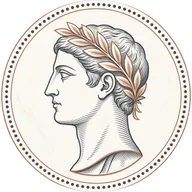
a.d. VI Id. Dec.
December 8 in Ancient Rome
Birth of Horace
birth65 BC
Pre-reform Roman calendar
a.d. VI Id. Dec. · as written (pre-Julian calendar)
Quintus Horatius Flaccus was born at Venusia, son of a freedman.
Horace
Background
Horace was born on 8 December 65 BC at Venusia (modern Venosa), a colony on the border of Apulia and Lucania. He gives the consular year himself (Odes 3.21: "born with me when Manlius was consul"), and Suetonius' Life gives the day per Suetonius.
His father was a freedman, a former enslaved man, who worked as a coactor, a collector of payments at auctions per Suetonius; Horace calls him a man of small farm. Horace insists that his father refused to send him to the local school with the sons of centurions and instead took him to Rome himself, escorting him to lessons and teaching him moral lessons by pointing to examples in the street (Satires 1.6). Later he studied philosophy in Athens.
The son of a freedman rising to be the friend of Maecenas and Augustus was unusual, and Horace was sensitive to sneers about his origins. His poems give rare glimpses of everyday Roman life: the crowded streets, a bore who will not leave him alone, a simple dinner of leeks and chickpeas, and the pleasures of his Sabine farm.
Before Caesar's reform (45 BC) the calendar had drifted from the seasons, so the real seasonal date was different; we don't give a modern equivalent. Why?
Ancient source: Suetonius, Vita Horati ('natus est VI Idus Decembris'); Horace, Odes 3.21.1 · Reference
Sources
☁ Rome today (1991–2020 avg): 13°/6°C (55°/43°F) · rain 36% of days
Rome in DecemberDecember's highlight was the Saturnalia (from 17 December).
Fields & crops
Olive picking and pressing, wood-cutting, and indoor work on rainy days; sowing ideally finished by the Kalends per Columella 11.2.
Courts & law
Courts closed for the Saturnalia; quaestors gave gladiatorial shows in December in late antiquity per the Chronography of 354.
Senate & politics
New tribunes of the plebs entered office on 10 December; outgoing magistrates closed their accounts before the year ended Republic.
Military
Winter quarters. Soldiers too kept the Saturnalia, choosing a mock 'king' per the Acts of Dasius, a late and disputed martyr text.
Festivals & religion
Faunalia (5 Dec.), Agonalia and Septimontium (11 Dec.), Consualia (15 Dec.), Saturnalia (from 17 Dec.), Opalia (19 Dec.), Divalia (21 Dec.), Larentalia (23 Dec.), and later the birthday of Sol Invictus (25 Dec.).
Daily life
December's highlight was the Saturnalia (from 17 December). Business stopped, people wore the casual pilleus cap and gave small gifts, and households let enslaved people eat with, or even be served by, their owners per Macrobius 1.7, Seneca Ep. 47. Seneca, though, notes that the inversion lasted only days; the rest of the year enslaved people stood silent and hungry while masters dined, and could be beaten for a cough per Seneca, Ep. 47. Seneca himself grumbled that the whole city "sweats" with feasting Seneca, Ep. 18.
On farms, olives were picked and pressed, and enslaved workers repaired tools and baskets on rainy days per Columella 11.2.
Sources: Varro, De Lingua Latina 6 · Chronography of 354 · Seneca, Epistles 18 and 47 · Macrobius, Saturnalia 1.7–10
All days in December →
LATIN LINE OF THE DAY
Non est vivere, sed valere vita est.
“Life is not just being alive, but being well.”
Martial, Epigrams 6.70 · translation ours (literal)